


From Sambar Deer to Rabbits: How to Choose a Knife for Different Game Types
Knives are the backbone of any hunt. They are cool to look at, exciting to buy, and a pleasure to toy around with, which can create a sort of problem for hunters, who often tend to accumulate a lot of excess blades, yet not one perfectly suited to the game at hand.
In the Land Down Under, hunting opportunities can range from rabbits to massive water buffalo. When it comes to big and small game across the country, the hunting knives Australia offers can handle the unique challenges of each animal.
So, when shopping for hunting knives in Australia, it pays to look beyond appearance and focus on purpose.
Contents
Blades for Big Game Hunting
Big game hunting in the country refers to pursuing animals that weigh more than 160 kilograms. Among the most sought-after hunts are water buffalo, banteng, feral pigs, and a host of deer species, including sambar, hog deer, red deer, fallow deer, and rusa deer.
Among Australia’s big game species, sambar holds a top-tier status. Wild and powerful, this animal is one of the toughest deer species, worth every step in Victoria’s rugged High Country. Filled with sharp ridgelines, deep gullies, and rocky slopes, this environment is no place for the unprepared. It demands proper planning and a reliable hunting knife at your side.
When hunting for sambar, you’ll need a sturdy fixed blade that can handle large game, thick hide, and demanding field dressing conditions. In general, fixed knives are stronger than folding models and won’t fail under pressure. Size-wise, the blade length for sambar hunting sits around 9–15 cm, offering enough reach to handle thick hide and heavy muscle while still giving you the control needed for precise field work.
As already mentioned, the demanding conditions of Victoria’s rugged High Country call for gear that can handle moisture, mud, and constant exposure to the elements. This said, blades made from high-quality stainless steel are a popular choice, thanks to their resistance to rust and ability to handle wet, muddy environments.
High carbon steel is also a go-to option because it’s tough and can hold a sharp edge through demanding use. Paired with a durable handle made from materials like Micarta, G10, or textured rubber, this combination ensures your knife remains steady and reliable when processing large game.
Water buffalo are another branch of Australian big game. They’re massive (some bulls can weigh over 700 kilograms), strong, unpredictable, and often aggressive when approached. Their tough hide, thick muscles, and sheer size demand the right hunting tools, like a heavy-duty fixed knife that’s around 12–18 cm long with a robust, high-carbon or stainless steel blade that can cut through dense muscle and tough hide.
Blades for Small Game Hunting
Small game animals in Australia are generally mammals that weigh under 23 kilograms. This category includes species such as rabbits, foxes, hares, feral cats and wild dogs, hunted across farmland, state forests, and designated hunting areas. These animals are most often pursued for pest control, as many are introduced species that threaten native wildlife, damage crops, and harm livestock.
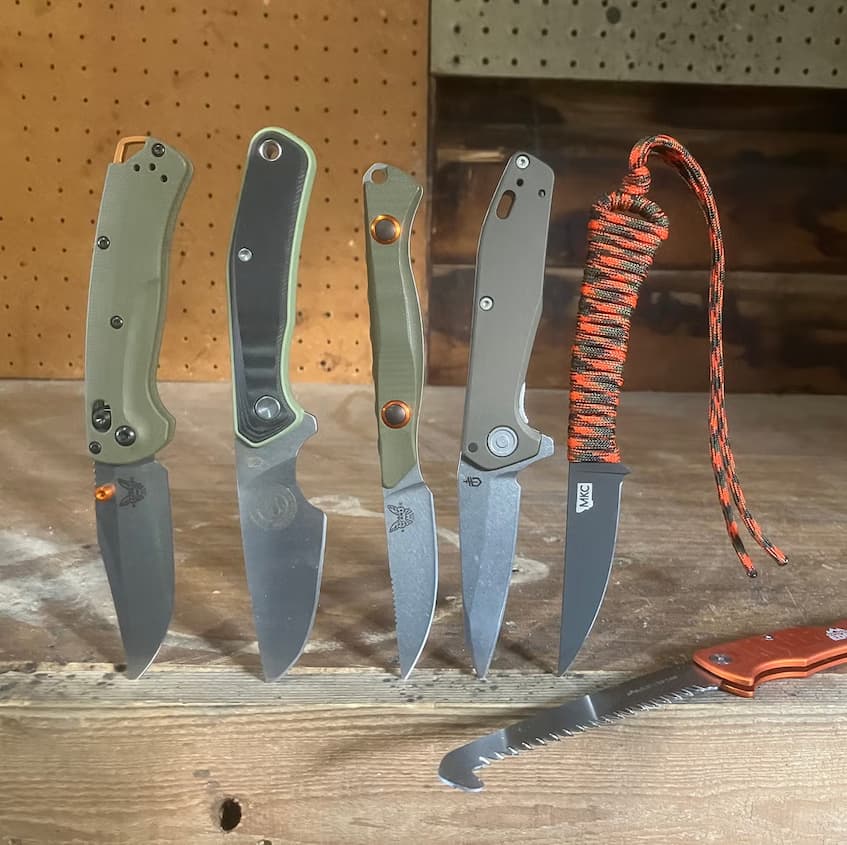
Unlike big game hunting, where bulkier and heavy-duty blades are used to handle thick hide and dense muscle, small game hunting calls for lighter and more precise blades that can handle delicate cuts. A smaller blade, usually around 7–10 cm, allows you to make clean, accurate cuts without damaging delicate meat and valuable fur. They reduce waste, improve precision, and make the entire process smoother from start to finish.
Also, smaller tools are easier to manoeuvre when performing detailed tasks like skinning and field dressing in tighter areas. Their lighter weight also makes them more comfortable to carry, whether clipped to your belt or stored in your pack. Design-wise, foldable knives are easy to carry in a pocket or belt sheath, which is perfect for hunters moving quickly across terrain and checking multiple spots in a day.
Furthermore, foldable knives also tend to be quicker to deploy, letting you respond efficiently when opportunity strikes. While they may not have the brute strength of a fixed blade, their portability, convenience, and versatility often outweigh that limitation for small game tasks.
Blades for Both Big and Small Game
If you hunt both big and small game, consider investing in a knife that’s light enough to pack out for medium game but durable enough to gut, cape, skin, and debone big game animals. The right blade should be a combination of thinness, lightness, sharpness, and toughness.
If you can only bring one knife on your hunt, make it a versatile all-rounder. Look for a design that features a versatile drop-point shape for caping, skinning, and deboning, a compact size to suit both large and small prey, and a durable, non-slip handle for strength and grip in muddy and wet conditions.
Sorry, the comment form is closed at this time.